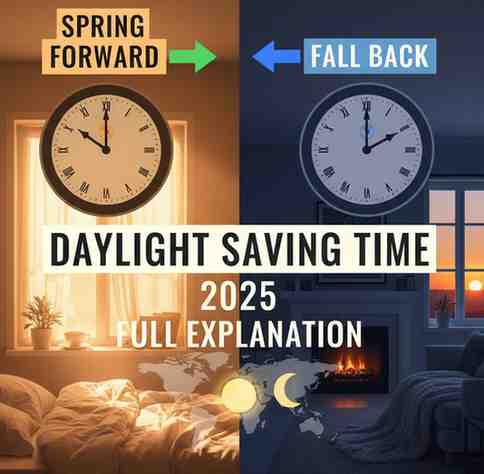
How Daylight Saving Time Works in 2025 – Full Explanation
 Download article
-
What Is Daylight Saving Time?
-
Daylight Saving Time 2025 – Start Date and End Date
-
Does India Observe Daylight Saving Time?
-
Why Do Some Countries Observe DST?
-
Disadvantages of DST
-
Conclusion
"Daylight Saving Time 2025 explained – when it starts and ends, how it works, and whether India follows DST."
We all know that there are 24 hours in a day. But sometimes, the clocks go back twice a year!
This phenomenon is called Daylight Saving Time (DST).
What Is Daylight Saving Time?
Daylight Saving Time, or DST, is a system applied in many countries to save energy by making better use of the natural sunlight during the summer.
When DST starts, individuals advance their clocks by one hour in order to prolong daylight in the evening.
When it ends, clocks are shifted back by one hour to normal time.
This minor time change makes people get more daylight after work or school, and it was initially implemented to conserve electricity by cutting down on the utilization of artificial lighting.
Daylight Saving Time 2025 – Start Date and End Date
In the United States (USA):
- DST starts on March 9, 2025 (Sunday) – clocks advance one hour at 2:00 AM → 3:00 AM.
- DST ends on 2nd November 2025 (Sunday) – clocks go back one hour at 2:00 AM → 1:00 AM.
In Europe (UK / EU nations):
- DST starts on 30th March 2025
- DST ends on 26th October 2025
Between these months, the India time difference with these areas varies. For instance, when DST begins, India shifts to 30 minutes "nearer" to the likes of the UK or some parts of Europe.
Does India Observe Daylight Saving Time?
No, India does not observe Daylight Saving Time.
India observes IST (Indian Standard Time), i.e., UTC +5:30 all year round.
Since India is on the equator, sunrise and sunset times don't differ significantly between summer and winter — hence DST is not needed.
That's why clocks in India don't change year-round like in North American or European countries.
Why Do Some Countries Observe DST?
The nations that lie far from the equator have a big variation in daylight between winter and summer.
DST assists them in altering their daily routines to utilize sunlight more efficiently.
Following are some of the reasons why DST is employed:
- To conserve electricity – Greater daylight translates into less light utilized during the evening.
- To enhance productivity – Longer evenings promote outdoor and social activity.
- To harmonize business hours – Facilitates international trade and communications with overlapping daylight.
Disadvantages of DST
Despite the advantages of DST, there are some disadvantages too:
- The abrupt change in time may interfere with sleep patterns and wellbeing.
- It can produce confusion in travel, technological systems, and international meetings.
- The real energy savings are usually marginal or even zero in the era of today.
Due to these reasons, some countries have eliminated DST in recent years.
Conclusion
Daylight Saving Time 2025 will start in March and end in November in the United States as well as in most of Europe.
The primary concept behind DST is to utilize more sunlight in longer summer days.
India does not follow Daylight Saving Time since the country's daylight lasts reasonably consistently during the year.
If you have clients from overseas, go to international meetings, or track world events — take DST adjustments into account, as time zones may change for a several-month period annually.
References
Explore Topic's

| Total Posts | 6 |